Submarine telecommunication cables cross every ocean basin, and there is growing evidence that they can be turned into a dense, permanent observing infrastructure for the deep sea, a part of the ocean that remains largely unmonitored. Turning that potential into an operational reality requires far more than sensing technology: it raises questions of deployment and maintenance, environmental and societal impacts, data sharing, law, and maritime security.
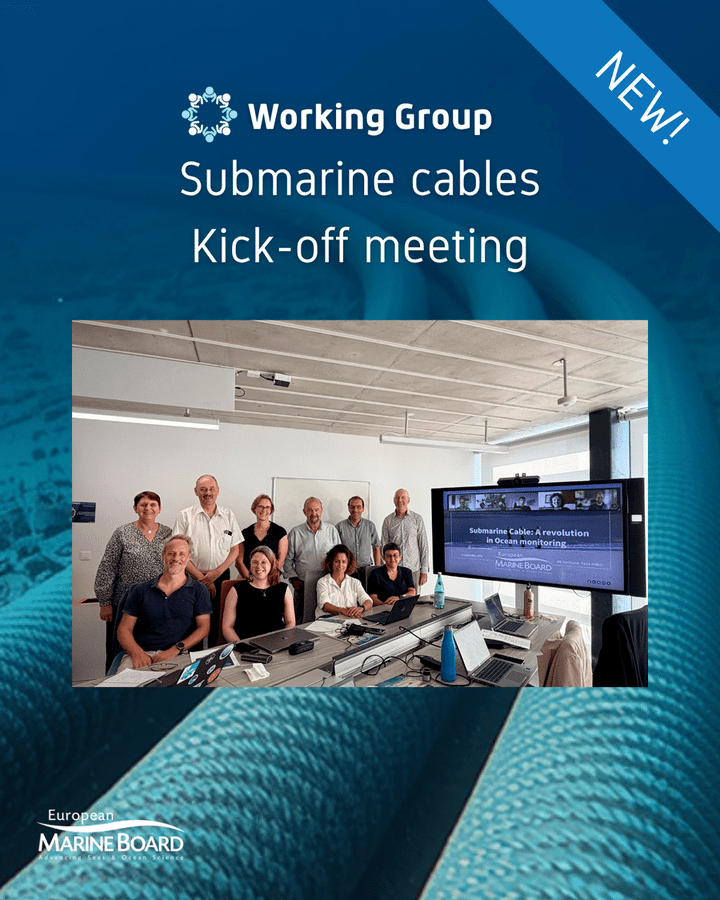
This is the objective of the new European Marine Board (EMB) Working Group on “Submarine Cables: A Revolution in Ocean Monitoring”, whose kick-off meeting was held on 8 September 2026 at IMREDD, Université Côte d’Azur, in Nice, following an introductory meeting on 29 June 2026.
Aims of the Working Group
The Working Group will produce a comprehensive state-of-the-art overview of the use of submarine cables for ocean monitoring, considering now obsolete, currently active, and newly laid telecommunication cables. Its scope covers:
- the monitoring opportunities offered by the different sensing technologies that can be applied to submarine cables, and their respective advantages and limitations;
- the practical requirements of deploying and maintaining such systems;
- their environmental and social implications;
- the legal implications of acquiring, sharing and using the resulting data;
- the maritime defence and security dimension, both for protecting the infrastructure and for detecting threats;
- research and policy recommendations to further develop the technology and its use in ocean observing.
A central question throughout is how cable-based systems can complement the existing ocean observing system, contributing to the Global Ocean Observing System and Essential Ocean Variables, and deliver a concrete service to society, from geohazard early warning to climate and biodiversity monitoring.
The group brings together 12 experts from across Europe, combining expertise in submarine cable technology, cable-based sensing and the information it delivers, legal and geopolitical aspects, and the impacts of using such systems. I am chairing this working group with Luciana das Neves (CIIMAR, Portugal) as Co-Chair, and provides input to the UN Decade of Ocean Science for Sustainable Development.
The Working Group will deliver an EMB Position Paper in late 2027.
Working Group members
- Chair: Anthony Sladen, CNRS – Géoazur – Université Côte d’Azur – Observatoire de la Côte d’Azur, France
- Co-Chair: Luciana das Neves, CIIMAR, Portugal
- Chris Bean, Dublin Institute for Advanced Studies (DIAS), Ireland
- Giuseppa Buscaino, CNR-IAS, Italy
- Michael Clare, National Oceanography Centre (NOC), UK
- Juanjo Dañobeitia, Consejo Superior de Investigaciones Científicas (CSIC), Spain
- Isabel Iglesias Fernandez, CIIMAR, Portugal
- Martin Landrø, Norwegian University of Science and Technology (NTNU), Norway
- Tobias Liebetrau, University of Copenhagen, Denmark
- Nele Matz-Lück, Kiel University, Germany
- Hrvoje Mihanović, Institute of Oceanography and Fisheries (IOF), Croatia
- Jens Schneider von Deimling, Kiel University, Germany
Thanks to Paula Kellett and the EMB Secretariat for facilitating the group, and to IMREDD for hosting the meeting in Nice.