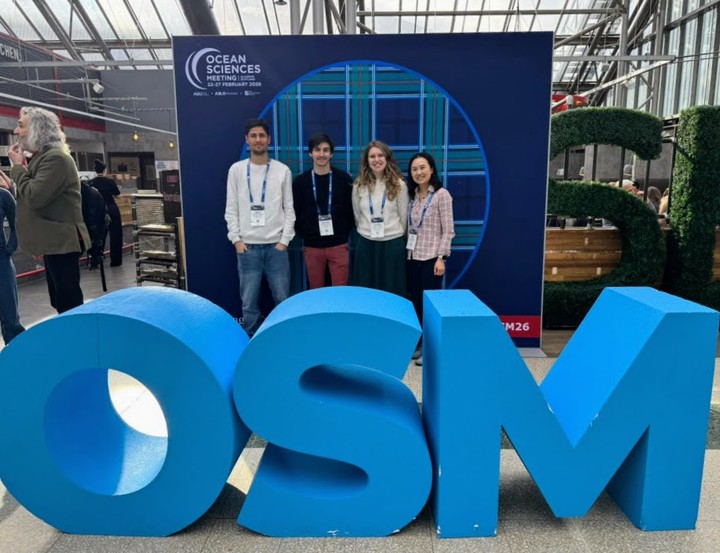
Our group will present four abstracts at the Ocean Sciences Meeting (OSM26) in Glasgow, Scotland.
The Ocean Sciences Meeting (OSM) is the flagship conference for the ocean sciences and the larger ocean-connected community.
Our Presentations
Spatiotemporal Mapping of Fish Choruses with Distributed Acoustic Sensing
Session details: Poster (ME14C-0323) · 4:00pm–6:00pm, Feb 23 (GMT)
Presenter: Antoine Eceiza
Authors: Antoine Eceiza, Anthony Sladen, Olivier Brunel, Nicolas Bonnet, Vincent Gaglio, Raphael Simonet, Frederic Mittaine, and Jean-Michel Cottalorda.
Read abstract
Underwater soundscapes provide critical information on fish behavior, distribution, and reproductive activity. In this work, we report the first field deployment of Distributed Acoustic Sensing (DAS) for fish passive acoustic monitoring in a natural coastal environment.
A 500 m fiber-optic cable was deployed offshore Monaco over heterogeneous rocky and sandy seabed. We detected calls from three Mediterranean species (Epinephelus marginatus, Sciaena umbra, and Ophidion rochei) and additional unidentified signals likely linked to other vocal species. Thanks to DAS spatial resolution, we identify sound activity zones that may correspond to aggregation and spawning areas.
This study demonstrates the potential of submarine-fiber DAS for continuous, real-time biodiversity monitoring in and around marine protected areas.
Temperature Effects and Applications of Distributed Acoustic Sensing in Subsea Environments
Session details: Poster (OT44E-1192)
Time: 4:00pm-6:00pm, Feb 26 (GMT)
Presenter: Chu-Fang Yang
Authors: Chu-Fang Yang, Anthony Sladen, Aurelien Ponte, Amine Mohammedi, Franck Dumas, Jean-Baptiste Roustan, Paschal Coyle, Sigmund Birkeland, and Joacim Jacobsen.
Read abstract
Monitoring temperature variability is essential for understanding subsea physical dynamics and ecosystem impacts, but conventional in situ methods are expensive and sparse. DAS can transform existing communication cables into high-resolution, real-time observing systems by measuring optical-path changes over tens of kilometers.
Using offshore southern France data, we compare low-frequency DAS strain signals with in situ temperature records from four stations down to 1000 m depth. DAS captures fluctuations consistent with in situ observations, with an estimated sensitivity near 0.01 K. Observed time lags and smoothing likely reflect thermal conduction, local hydrodynamics, cable configuration, and small-scale perturbations.
These results support DAS as a powerful multiscale framework for temperature-related process studies in subsea environments.
Advancing Fin Whale Monitoring in the Pelagos Sanctuary Using Distributed Acoustic Sensing
Session details: Oral (OT52A-01)
Time: 10:35am-10:45am, Feb 27 (GMT)
Presenter: Laurine Andres
Authors: Laurine Andres, Anthony Sladen, Jean-Xavier Dessa and Alister Trabattoni.
Read abstract
This study presents a validated framework for automatic fin-whale detection and localization using the Ligurian DAS Observatory (LIDO), based on a 160 km decommissioned telecom cable in the Pelagos Sanctuary.
Our approach combines machine-learning detection (YOLO), template matching, and multipath-arrival analysis for robust near real-time performance, with up to thousands of detections per day and ranges up to 50 km in favorable conditions. We examine how cable coupling, water-column stratification, and related environmental factors affect performance, and we use hydroacoustic ray tracing for localization.
Preliminary results, benchmarked against active seismic shots with fin-whale-like characteristics, show localization precision better than a few hundred meters. This supports dynamic ship-speed reduction strategies and demonstrates a replicable framework for marine-mammal conservation using existing cable infrastructure.
Monitoring the Earth’s Tidal Response in the Deep Ocean with Distributed Acoustic Sensing
Session details: Oral (OT52A-06)
Time: 11:25am-11:35am, Feb 27 (GMT)
Presenter: Amine Mohammedi
Authors: Amine Mohammedi, Anthony Sladen, Aurelien Ponte, Hans-Georg Scherneck, Frederic Bouchette, Jean-Paul Ampuero, Paschal Coyle, Sigmund Birkeland, Joacim Jacobsen, and Erlend Ronnekleiv.
Read abstract
Solid Earth tides and ocean tidal loading continuously deform the Earth, but long-period monitoring in the deep ocean is difficult because sustained high-sensitivity seafloor instrumentation is rare. We show that DAS can repurpose submarine telecommunication cables into dense, kilometer-scale strain arrays with nanostrain-level tidal sensitivity.
Although DAS data are strongly affected by instrumental 1/f noise at tidal frequencies, targeted processing and stacking recover hourly tidal signals. In the Mediterranean case study, the strong thermal stability of deep waters helps isolate geodynamic strain from temperature effects. Observations agree well with simulations, including complex orientation-dependent tidal responses along cable segments.
Beyond seismology and oceanography, these results highlight DAS as an emerging tool for seafloor geodesy and long-period geodynamic monitoring.
Meet Us at OSM26
If you are attending OSM26 in Glasgow, we would be glad to connect and discuss collaborations on DAS, ocean monitoring, marine biodiversity, and geodynamics.