Towards Tsunami Early-Warning with Distributed Acoustic Sensing: Expected Seafloor Strains Induced by Tsunamis
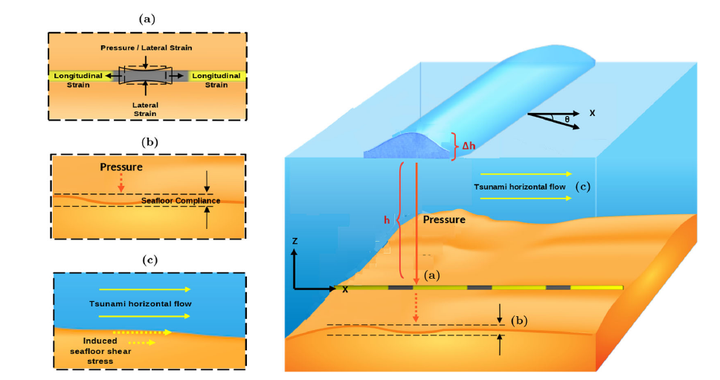 Conceptual summary of the physical processes by which a tsunami can induce a detectable DAS signature on a subsea fiber optic cable.
Abstract
This peer-reviewed study models the seafloor strain that tsunamis are expected to induce on submarine fiber optic cables observed with Distributed Acoustic Sensing (DAS). By combining theoretical developments, DAS detection-level considerations, and numerical tsunami simulations, it evaluates the potential of existing seafloor telecom cables for low-cost tsunami early warning, including in the near field. The results are encouraging and show that DAS can detect the expected signals, supporting its use in future operational warning systems. Congratulations to Carlos Becerril who lead this detailed work.
This paper is now out in its peer-reviewed journal version in Pure and Applied Geophysics.
It reflects a long collaborative effort with colleagues from France, Spain and the USA, covering the problem from theoretical equations and DAS detection levels to numerical simulations of tsunami-induced seafloor strain.
The main conclusion is encouraging: Distributed Acoustic Sensing on existing seafloor telecom cables appears to be a viable, low-cost path toward tsunami early warning, including in the near field where every minute matters.