Calving-driven fjord dynamics resolved by seafloor fibre sensing
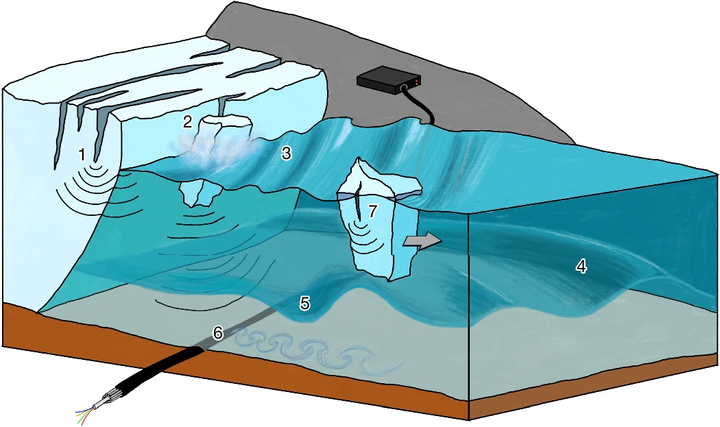 Glacier fracturing is observed by fibre sensing through its acoustic signature travelling through the fjord waters (1). Fracturing events coalesce into iceberg detachments that emit interface waves propagating along the seafloor (2). These detachments excite calving-induced tsunamis at the water surface that cause pressure perturbations along the fibre-optic cable (3). Calving-induced IGWs in the stratified fjord waters cause temperature variations at a given depth (4). Calved-off icebergs drift away from the glacier terminus and drag internal wave wakes behind them, which cause seafloor cooling by vertically displacing the stratified fjord waters (5). The internal wave wakes cause transient enhanced seafloor currents that generate vibrations in the cable through vortex shedding (6). Finally, icebergs disintegrate by fracturing, again detected by fibre sensing through its acoustic signals (7).
Abstract
Interactions between melting ice and a warming ocean drive the present-day retreat of tidewater glaciers of Greenland, with consequences for both sea level rise and the global climate system. Controlling glacier frontal ablation, these ice–ocean interactions involve chains of small-scale processes that link glacier calving—the detachment of icebergs—and submarine melt to the broader fjord dynamics. However, understanding these processes remains limited, in large part due to the challenge of making targeted observations in hazardous environments near calving fronts with sufficient temporal and spatial resolution. Here we show that iceberg calving can act as a submarine melt amplifier through excitation of transient internal waves. Our observations are based on front-proximal submarine fibre sensing of the iceberg calving process chain. In this chain, calving initiates with persistent ice fracturing that coalesces into iceberg detachment, which in turn excites local tsunamis, internal gravity waves and transient currents at the ice front before the icebergs eventually decay into fragments. Our observations show previously unknown pathways in which tidewater glaciers interact with a warming ocean and help close the ice front ablation budget, which current models struggle to do. These insights provide new process-scale understanding pertinent to retreating tidewater glaciers around the globe.